
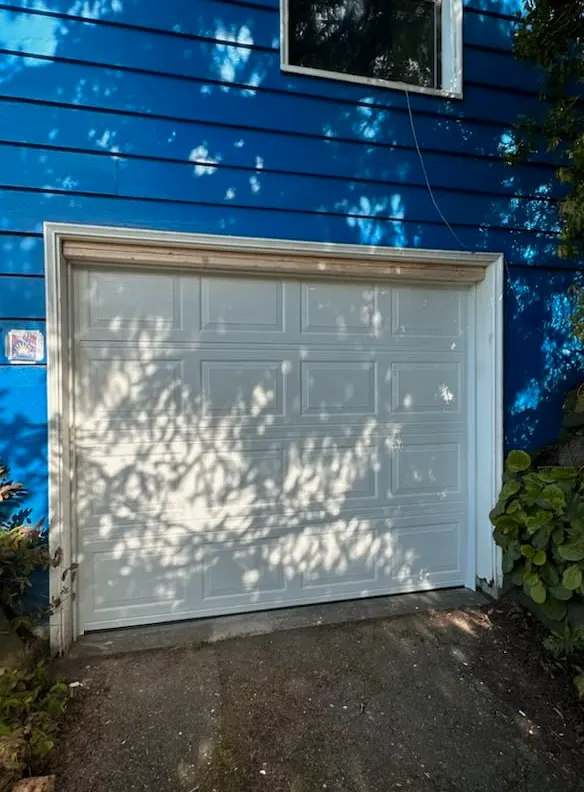
The Moment You Notice
You're thirty minutes into a workout, or halfway through sanding a cabinet door, when a gust off the bay rattles the garage door hard enough to make you look up. Or you pull the squat rack away from the wall and see a faint rust line creeping along the bottom panel where you never park a car to warm it up. Or the overhead light clicks on with the opener's motor and you realize, for the first time since you turned this space into a room, how loud that thing actually is. That's usually the moment one spouse turns to the other and says some version of "I thought we dealt with this."
You didn't, really. You dealt with the floor, the insulation in the walls, maybe a mini-split. The garage door — the biggest moving part of the room — mostly got left alone, and it's been quietly doing its own thing ever since.
The Door Doesn't Know the Room Changed
Here's the part worth settling before the argument goes further: converting a garage doesn't convert the door. It's still a garage door — same springs, same tracks, same opener, same panel material — even if nobody ever drives a car over the threshold again. That matters because a garage door is engineered around a very specific job: sealing out weather and holding its own weight while cycling open and shut a few times a day. Ask it to also be a wall of a finished room, and it starts showing the strain in ways that are easy to miss until you're standing in the space every day.
Three Things Converted Garages Usually Get Wrong
Insulation and Temperature Swings
A standard steel garage door panel is one of the least insulated surfaces in most Marin County homes. That's fine for a space that holds a car and some bins. It's a different story for a room with a bench press or a workbench in it. Inland spots like Terra Linda and Novato can get genuinely hot behind an uninsulated door in summer, while coastal pockets like Mill Valley or Corte Madera swing the other way — damp and chilly for months once the winter rain sets in. If the room feels unusable for half the year no matter what the thermostat says, the door is very likely the reason, not the walls.
Condensation and Quiet Rust
A door that's rarely opened traps humidity differently than one that gets worked daily. In a converted space, condensation can collect on the inside of the panels overnight, especially during the rainy season, and nobody notices because nobody's standing next to the door at 6 a.m. anymore. Add in salt air if you're closer to the water, or dust and wildfire smoke drawn in through old weatherstripping during the dry months, and you get the kind of slow corrosion that looks cosmetic until a panel starts to swell or a track starts to pit. It's not dramatic, which is exactly why it goes unaddressed in a room nobody associates with "garage maintenance" anymore.
Forgotten Maintenance and Blocked Safety Sensors
This is the one that actually worries a technician. When a garage stops being a garage, people stop doing the small habitual checks — listening for a new grinding noise, noticing a spring that's started to sag, watching the door open level instead of crooked. At the same time, converted garages tend to fill up with gym equipment, tool chests, or storage right along the base of the door, which is exactly where the photo-eye safety sensors live. Block those, even partially, and the opener may reverse unpredictably or stop working altogether — not a design flaw, just a door doing what it's supposed to do when it can't see clearly.
So: Fix It, Replace It, or Wall It In?
Once you've named the actual problem, the argument usually isn't about whether something needs to change — it's about which fix makes sense.
- Keep the working door, seal and insulate it. The cheapest path if the door itself is sound: add weatherstripping, an insulation kit, and make sure the opener and sensors are clear of equipment. Good for a workshop or storage-heavy setup where you still want the option to roll the door up for ventilation or to move large gear in and out.
- Replace it with an insulated door. Worth considering if you're using the room daily — a gym especially — and the temperature swings or condensation have gotten bad enough to affect the equipment or your motivation to use it. An insulated door also tends to be quieter, which matters if you've got an opener cycling while someone's mid-set a few feet away.
- Wall it in permanently. The most finished-feeling option, but it's a structural and sometimes seismic retrofit project, not a garage door job — if you're bolting a squat rack or heavy shelving to what used to be a door opening, that framing needs to be engineered for it, especially in an older Marin County home.
Most households land on the first or second option. Full wall-ins tend to make sense only when the garage has been a living space for years and the family has genuinely stopped wanting drive-in access.
When to Call San Rafael Garage Door
If you're hearing new noises, seeing rust or condensation along the panels, or the opener is reversing for no obvious reason, that's worth a visit before it becomes a bigger repair. We handle garage door maintenance checks that catch exactly this kind of slow damage — springs, tracks, sensors, seals — and if the door itself is the problem rather than just neglect, we can talk through garage door installation options built for insulation and noise, not just curb appeal. Either way, you'll know which spouse was right, and the door will actually match how the room gets used.
If your converted garage in San Rafael, San Anselmo, Novato, Mill Valley, or anywhere else in Marin County has started acting up, call San Rafael Garage Door and we'll come take a look.